
- I'm really excited that my short story, lost, will be included in the Tomo Anthology, a forthcoming benefit anthology of short fiction set in or related to Japan for readers ages 12 and up. Proceeds from the sale of Tomo will support teens affected by the Great East Japan Earthquake of March 11, 2011. It's such an honor to be included in this anthology, and a real blessing to be able to use my talents to help, if even in the smallest of ways.
- It's been a really terrific two weeks, book cover-wise. Both my US publisher (St. Martin's Press) and my UK publisher (Simon & Schuster) have sent me their respective covers for The Hunt. They're both very different, but incredible and awesome in their own ways. Both covers still need to be tweaked, and last-minute brush-ups are still being undertaken, but I can't wait to be able to show you in the near future. I've read so many horror stories of authors hating their covers, so I was a little worried. I shouldn't have been; I think both are terrific.
- I saw the film Warrior this past Friday. I was really blown away by the intelligent filmmaking and acting. Although sometimes almost slipping into the maudlin, it stayed true to its vision. The last few minutes of the film, including that tap, were heart-wrenching.
Monday, September 12, 2011
random thoughts
I'm plunged deep into writing Book 2 right now, so my thoughts are a little scattered, but . ..

Sunday, August 21, 2011
The decline in boy readers and boy protagonists. Relationship?
The decline in boy readership is well-documented. In a recent New York Times article by Robert Lipsyte, a number of reasons are suggested for this disturbing trend.
- Boys gravitate toward nonfiction;
- Books with story lines about disease, divorce, death and dysfunction sell better for girls than do similar books for boys;
- While teenage girls will read books about boys, teenage boys will rarely read books with predominately female characters;
- Today’s books for boys are simply inferior: supernatural space-and-sword epics that read like video game manuals and sports novels with preachy moral messages, and which often seem like cynical appeals to the lowest common denominator.
Whatever might be the actual root cause – and there is some debate – there is little debate that the YA market today largely caters to the female reader demographic. To quote Lipsyte: “At the 2007 A.L.A. conference, a Harper executive said at least three-quarters of her target audience were girls, and they wanted to read about mean girls, gossip girls, frenemies and vampires.”
In other words, acquisition and marketing decisions by publishers are being made with this female readership in mind, and this indubitably affects other considerations down the road such as cover design and promotion strategies. The end product is leaving the teenage boys cold. And so the downward trend continues. Or so the theory goes.
Anyway, without entering too deeply into the current debate, I thought it might be interesting to see what percentage of YA books being released in the remainder of 2011 features a male protagonist. If the theory is true that teenage boys will rarely read books with a female protagonist (Hunger Games excepting), and if the Harper executive is correct (boys are only 25% of target audience), then you’d expect to see about 25% of the YA books featuring a male protagonist.

My analysis is by no means an exact science, and I certainly don’t hold it out to be one. Using the list of upcoming YA titles through 2011 from www.YALit.com, I took a tally of the number of books with male (and female) protagonists. I did not include MG books or anthologies. To aid me in deciding the gender of the protagonist, I used the book’s description on Amazon; where that was inconclusive, I looked at the book cover to further guide me: did it predominantly feature a male or female? On occasion, where even that proved to be insufficient, I would check out the author’s website for more information. You can look at my full results here (and of course, let me know where I made a mistake! Again, this was just a rough-shod tally. Give me an intern and 5 hours, and I’ll give you an error-free analysis!).
There were times when I simply could not discern the gender of the protagonist. Sometimes, the book’s description gave inadequate information. Other times, the book’s synopsis suggested male and female main characters, and the cover featured both a male and female model. Paul Griffin’s Stay With Me is a good example of this. A few books, like Marie Lu’s Legend, feature alternating perspectives of a male and female protagonist. For books such as these, I decided not designate a male or female protagonist, and did not include that book in my final tally.
The result: Out of 104 YA titles coming out in the remainder of 2011, 27 of them feature male protagonists. That is 26%.
Which is pretty darn close to the aforementioned 25%.
Some other interesting tidbits of info:
Number of female authors who wrote books with a male protagonist: 10
Number of male authors who wrote books with a female protagonist: 1 (Clive Barker’s Abarat 3:Absolute Midnight).
Who knew? 50 Cent is a YA author!
Monday, August 1, 2011
writerly inspirations
July was not a good blogging month for me! But August will be different. See, it's only August 1st and I already have a blog up.
One of the questions I often get is how I get my ideas. I'm never really sure how to answer because inspiration hits me in varied ways and places, and they often evolve so gradually before crystallizing into the final form that I can't really articulate where or how I got the "idea."
But there are two activities that - for me, at least - really seem to let loose the creative juices. One of them is running. I love to put on my running shoes, snap on my Garmin watch, plug in my earphones, and just take off. By the time I've hit mile two or three and my body is warmed up, my brain unlocks. The dam breaks, and creative waters start flowing. Plot holes, character issues, etc. etc., all seem to find obvious solutions.
The second activity is taking a shower. Something about the white noise of water splashing, the soothing impact of hot water spraying off me, has a calming impact on me, and in that zen mode, ideas really seem to rain down on me. I read a blog somewhere about one author who kept a diver's board in his shower to jot down his ideas so I guess I'm not the only one.
And sometimes, inspiration can come in the weirdest form. Last week, I was really stuck plot-wise with something in Book II, and neither running nor showering seemed to help. I was getting pretty frustrated when I read a retweet from someone in Simon and Schuster (UK) who had read The Hunt. That person (@kat99999) mentioned that listening to The National's High Violet had invoked thoughts about The Hunt because both were "haunting and creepy." That piqued my curiosity so I listened to the album. And wouldn't you know it, ten minutes later, as I listened to the album, my fingers started to dance across the keyboard. Writer's block, unblocked. Thanks, @kat9999.
One of the questions I often get is how I get my ideas. I'm never really sure how to answer because inspiration hits me in varied ways and places, and they often evolve so gradually before crystallizing into the final form that I can't really articulate where or how I got the "idea."
But there are two activities that - for me, at least - really seem to let loose the creative juices. One of them is running. I love to put on my running shoes, snap on my Garmin watch, plug in my earphones, and just take off. By the time I've hit mile two or three and my body is warmed up, my brain unlocks. The dam breaks, and creative waters start flowing. Plot holes, character issues, etc. etc., all seem to find obvious solutions.
The second activity is taking a shower. Something about the white noise of water splashing, the soothing impact of hot water spraying off me, has a calming impact on me, and in that zen mode, ideas really seem to rain down on me. I read a blog somewhere about one author who kept a diver's board in his shower to jot down his ideas so I guess I'm not the only one.
And sometimes, inspiration can come in the weirdest form. Last week, I was really stuck plot-wise with something in Book II, and neither running nor showering seemed to help. I was getting pretty frustrated when I read a retweet from someone in Simon and Schuster (UK) who had read The Hunt. That person (@kat99999) mentioned that listening to The National's High Violet had invoked thoughts about The Hunt because both were "haunting and creepy." That piqued my curiosity so I listened to the album. And wouldn't you know it, ten minutes later, as I listened to the album, my fingers started to dance across the keyboard. Writer's block, unblocked. Thanks, @kat9999.
Wednesday, June 22, 2011
On writing the sequel
A few months ago, my trilogy was picked up by St. Martin’s Press. The first book, titled The Hunt, is due to be published in Spring of 2012.
I’m now working on the second book in the trilogy.
It’s a strange place to be in.
You’re writing full-time but, with the publication date for Book One almost a year away, it somehow doesn’t feel quite real. There’s no tangible proof that you’re an author: you can’t go into a bookstore and hold your book aloft, you don’t have readers emailing you, you don’t have a book cover or even design mock-ups to show yet. Your blog has one consistent reader (and he doesn’t count, because he’s your brother).
But it’s also a really neat place to be in. Because it’s given me the necessary space and time I need to plunge myself into the sequel without the distraction of marketing/promotional work. I know that time is coming (in about only a year!) when I’ll be promoting Book 1, editing Book 2, and writing Book 3, when I’ll wistfully look back to these quieter, more spacious days.
The internet is rife with blogs about just how much work it takes to write a good Book 2 of a trilogy. Let me tell you: they’re right. Writing the second book is challenging. It has to advance story arcs, develop character relationships, deepen mystery threads, all the while without bringing final resolution. Yet it has to stand on its own, provide in its own way some level of resolution and plot climax. Pictorially, I liken Book 2 to an enticing bridge that people can’t wait to get on, provides enjoyment for those crossing it, but which also leaves them hungry for more, eager to embark on the next leg of the journey. A tall task!
Which leads me back to why I love the quiet and space the next few months will afford me. Every day I wake up, knowing that I’ll have a chunk of time to dive into the world of Gene and the hepers, and the joy that brings me is at times intoxicating. That’s not to suggest there aren’t difficult (and sometimes %@#! frustrating) days; I’ve had many, and there’ll be plenty more ahead. But I love the feeling of turning on my computer, setting my ice coffee down next to me, and having the next few hours to make real the imaginary world in my head. It's a pure time, when all I have to measure my day's success is whether the pages I write are internally true to my own vision. When I won't be affected by reader's expectations (I read somewhere that it's the expectations of the glowing reviewers - and not the bad ones - who can most affect your vision) but only by my inner compass of uncompromised rightness.
Wednesday, May 25, 2011
The goal is not to get to the finish line.
Writing a book is long journey, one rife with all kinds of obstacles and hurdles. Plot, thematic coherence, characterization, dialogue, etc. - any one of these can become the barrier that proves insurmountable, pushing that manuscript into the forgotten recesses of your computer's hard drive. Every author I've spoken with has encountered at least one significant hurdle in the writing of a novel, and each has had to deal with it. These can be considerable setbacks, sometimes lasting several months as the author wrestles with the hurdle. But this is the point - the author wrestles and deals with it, refusing to simply quick-fix the problem with a roughshod job, because (s)he knows the novel will be all the better for their efforts. It's what transforms a mediocre novel into an unforgettable one.
Of course, you can just ignore the problem points and rush to the end, impatient to finally type THE END. Trouble is, if you don't fix the problems, if you just bludgeon your way past and through the hurdles, you may get to the finishing line, but you have not exactly won the race. See the hurdler in video below.
When my agent, Catherine Drayton, told me that there were some "hurdles" that had to be dealt with before submitting to the publishing houses, I wanted to pull my hair out. When I realized that these were not quick fixes but would require a bit of actual thought, creativity, and work, I wanted to pull my teeth out. Then I wanted to pull her teeth out. What I wanted was for her to submit the manuscript yesterday, already.
I'm so glad she didn't. Catherine was so spot-on in her critique. It took work - hard, bruising work - but it ultimately made the novel that much better. It was a good reminder that the point is not simply to write a novel, blazing through all the hurdles, but to take the time and effort to write an AWESOME one. And that means playing by the rules, putting the time in.
http://www.youtube.com/watch?v=ewckPYePzbU&feature=player_embedded
Of course, you can just ignore the problem points and rush to the end, impatient to finally type THE END. Trouble is, if you don't fix the problems, if you just bludgeon your way past and through the hurdles, you may get to the finishing line, but you have not exactly won the race. See the hurdler in video below.
When my agent, Catherine Drayton, told me that there were some "hurdles" that had to be dealt with before submitting to the publishing houses, I wanted to pull my hair out. When I realized that these were not quick fixes but would require a bit of actual thought, creativity, and work, I wanted to pull my teeth out. Then I wanted to pull her teeth out. What I wanted was for her to submit the manuscript yesterday, already.
I'm so glad she didn't. Catherine was so spot-on in her critique. It took work - hard, bruising work - but it ultimately made the novel that much better. It was a good reminder that the point is not simply to write a novel, blazing through all the hurdles, but to take the time and effort to write an AWESOME one. And that means playing by the rules, putting the time in.
http://www.youtube.com/watch?v=ewckPYePzbU&feature=player_embedded
Friday, May 13, 2011
How my writer's block saved a cat
This morning, I was suffering from a bad case of writer's block. I did what I usually do when the writing doesn't flow: I drove to a nature preserve and put on my running shoes. Running has this way of unclogging my brain, something Nathan Bransford (whose excellent Wonderbar novel launched this week) (yes, that was a shameless piece of product placement) has also found effective.
Anyway, after my run, just as I was about to get into my car, I heard a meowing. I was in a desolate parking lot in the middle of nowhere, so my curiosity was piqued. I looked down, and this is what I found:
I'm not a cat person - I'm firmly Team Dog - but something about this cat broke me inside. It was famished, thirsty, and frail. When I patted it, it was sticks & bones. But clearly domesticated - it didn't have a feral bone in it. I poured it some water and it lapped it up. Finished a whole bottle, in fact. It kept meowing, clearly hungry. And it was starving for affection - it kept trying to rub its body on my leg. And then it crawled under my car, coming out only when it wanted to rub its body on my leg again.
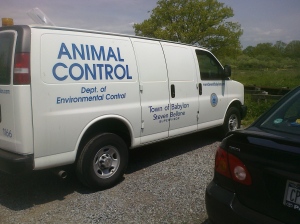
I couldn't leave it, so I called the animal shelter. They were great - they got there within minutes. The staff lady calmly put it into a box, then into the van. She told me a cat owner had called about a week ago, frantic about a cat she'd lost at that very nature preserve. Hopefully, this is the same cat, and there's a happy ending to this story. I'm going to call the shelter next week and make sure this cat found its owner. If not, I might just head down to the shelter myself and adopt the cat. It did a number on me, it did.
Anyway, this just goes to show that writer's block isn't always a terrible thing.

Anyway, after my run, just as I was about to get into my car, I heard a meowing. I was in a desolate parking lot in the middle of nowhere, so my curiosity was piqued. I looked down, and this is what I found:

I'm not a cat person - I'm firmly Team Dog - but something about this cat broke me inside. It was famished, thirsty, and frail. When I patted it, it was sticks & bones. But clearly domesticated - it didn't have a feral bone in it. I poured it some water and it lapped it up. Finished a whole bottle, in fact. It kept meowing, clearly hungry. And it was starving for affection - it kept trying to rub its body on my leg. And then it crawled under my car, coming out only when it wanted to rub its body on my leg again.
 (its eyes are focused on my leg it wanted to rub against. again.)
I couldn't leave it, so I called the animal shelter. They were great - they got there within minutes. The staff lady calmly put it into a box, then into the van. She told me a cat owner had called about a week ago, frantic about a cat she'd lost at that very nature preserve. Hopefully, this is the same cat, and there's a happy ending to this story. I'm going to call the shelter next week and make sure this cat found its owner. If not, I might just head down to the shelter myself and adopt the cat. It did a number on me, it did.
Anyway, this just goes to show that writer's block isn't always a terrible thing.


Tuesday, May 10, 2011
Soba Ni Iru Ne by Thelma Aoyama
I might make this a regular feature on this blog: a weekly peek into Asian culture (music, movies, books). I'll keep it to one video (or movie scene/excerpt) a week, featuring an aspect of Asian culture that the western hemisphere is missing out on.
This week, I'm featuring a song, Soba Ni Iru Ne by Thelma Aoyama. In my mind, it's an instant Top Ten song simply begging to be translated and brought over here. Beyonce (featuring Usher) would rock this song.
Not that Thelma Aoyoma is any kind of slouch, either. She grooves, silky smooth. Part Afro-Trinidadian and part Japanese, Thelma brings so much nuance and depth to this song.
Also, there's a companion song Koko ni iru yo. Same song with a heavier emphasis on the soft rap male part. Nice video, though not quite as good a song, in my estimation. Those of you who speak Japanese must love the ne and yo ending of both song titles.
http://www.youtube.com/watch?v=5ndRYEIQG9o&feature=relmfu
This week, I'm featuring a song, Soba Ni Iru Ne by Thelma Aoyama. In my mind, it's an instant Top Ten song simply begging to be translated and brought over here. Beyonce (featuring Usher) would rock this song.
Not that Thelma Aoyoma is any kind of slouch, either. She grooves, silky smooth. Part Afro-Trinidadian and part Japanese, Thelma brings so much nuance and depth to this song.
Also, there's a companion song Koko ni iru yo. Same song with a heavier emphasis on the soft rap male part. Nice video, though not quite as good a song, in my estimation. Those of you who speak Japanese must love the ne and yo ending of both song titles.
http://www.youtube.com/watch?v=5ndRYEIQG9o&feature=relmfu
Subscribe to:
Posts (Atom)


